
IndiGo Crisis – Legal Correlation with Companies Act, 2013 | Published on Linkedin Blog
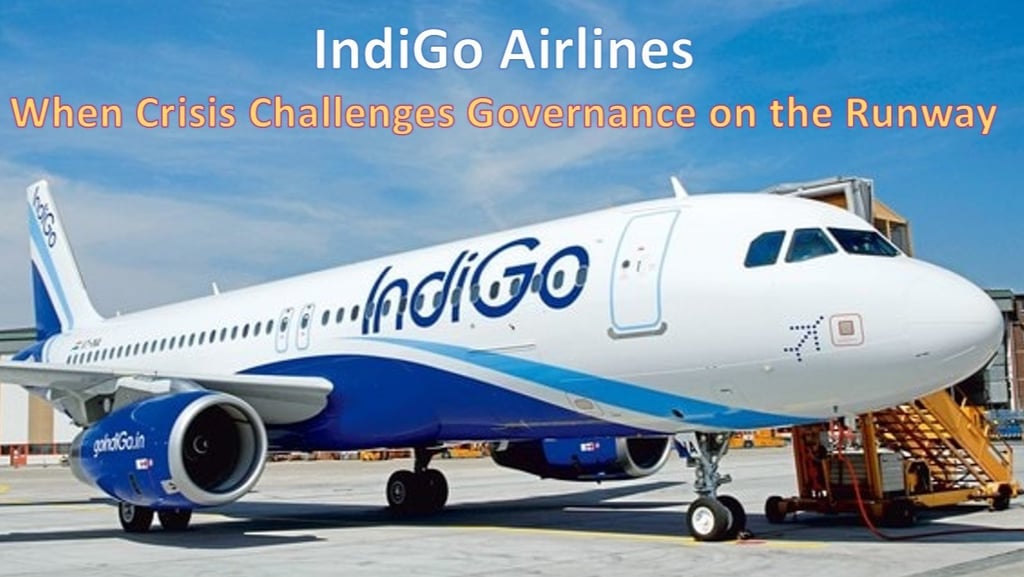
IndiGo Crisis – Companies Act, 2013 perspective
BLOG
Brahmanand Savanth
1/7/20263 min read
(Independent Director & Governance Lens)
1. Failure of Strategic Risk Anticipation
(Regulatory change → crew unavailability → mass cancellations)
Applicable Law:
Section 134(3)(n) – Board’s Responsibility Statement
The Board must confirm that proper systems to ensure compliance with all applicable laws were in place and operating effectively.
What went wrong: The November 1 DGCA pilot rest regulations were foreseeable. Failure to model their operational impact means the board cannot truthfully affirm effective compliance systems.
What should have been done (legally):
Mandatory regulatory impact assessment should have been tabled before Nov 1.
The Board should have minuted: Risk severity Crew shortfall probability Mitigation funding approvals
Corrective Action (Now Required):
Independent compliance audit
Revised Section 134 Responsibility affirmation in the next Annual Report with corrective disclosure.
2. Risk Management Failure
(Absence of systemic early-warning mechanisms)
Applicable Law:
Section 177(4)(vii) – Audit Committee
Mandates the Audit Committee to evaluate internal financial controls and risk management systems.
SEBI LODR Regulation 21 (for listed companies like IndiGo)
Requires an effective Risk Management Committee for top 500 listed entities.
What went wrong:
No early flag on: Pilot utilization nearing legal fatigue limits Schedule fragility Reserve crew deficiency
This indicates ineffective enterprise risk mechanisms.
What legally should have been done:
Weekly operational risk heatmap to Audit & Risk Committees
Scenario modeling under “High Impact–High Probability” risk category
Mandatory mitigation capital provisioning
Immediate Legal Correction:
Reconstitution of Risk Committee charter
Appointment of aviation safety & fatigue risk experts as permanent advisors
3. Independent Directors’ Fiduciary Duty
(Oversight, diligence, stakeholder protection)
Applicable Law:
Section 149(12) – Liability of Independent Directors
Independents are liable only when acts occurred with their knowledge, consent, or failure to act diligently.
Schedule IV – Code for Independent Directors
Key mandates:
Safeguard stakeholder interests
Balance board decision-making
Satisfy themselves on integrity of financial & risk systems
Demand adequate flow of information
Governance Gap Observed: If the board was not provided early indicators on crew risk:
It signals management suppression or weak reporting
But if indicators were provided and not acted upon → Independent Directors’ failure of diligence
What Independents should have done (as per Schedule IV):
Called for special board meeting pre-Nov 1
Sought third-party aviation safety opinion
Demanded quantified “flight disruption exposure index”
Now Required Legally:
Independent Directors’ separate meeting (mandatory under Schedule IV)
Formal performance evaluation of: CEO Head of Operations CRO / Compliance Head
4. Operational & Internal Control Breakdown
(Crew rostering, IT systems, fatigue compliance)
Applicable Law:
Section 134(5)(e) – Internal Financial Controls
Directors must confirm existence of adequate internal financial & operational controls.
Crew rostering systems, flight scheduling engines, fatigue compliance tools fall squarely under “internal controls” for an airline.
What failed:
Inability to dynamically reassign crews
Absence of buffer capacity
Failure of stress-tested operational recovery systems
Legal Expectation:
Independent IT & Operations Control Audit
Certification of “Operational Internal Controls” similar to financial IFC
Disclosure Obligation: Any material weakness must be disclosed in Directors’ Report & Annual Report.
5. Stakeholder Protection & Consumer Impact
(Passenger hardship, refunds, political pressure)
Applicable Law:
Section 166(2) – Directors’ Duties
Directors must act in good faith to promote the objects of the company for the benefit of members, employees, customers, and community.
What failed: Disrupted passengers, lack of uniform relief policy, ministerial intervention → clear stakeholder interest erosion.
What should have happened:
Immediate board-approved: Uniform refund & accommodation policy Customer compensation fund
Failure exposes directors to:
Breach of fiduciary duty (Section 166)
Reputational litigation risk
6. Executive Accountability & Possible Board Reconstitution
(DGCA show-cause to CEO)
Applicable Law:
Section 178 – Nomination & Remuneration Committee (NRC)
Mandates NRC to:
Lay down performance evaluation criteria for directors & KMP
Recommend removal when performance materially fails
Section 203 – Key Managerial Personnel Responsibility
What Law Demands Now:
NRC must perform special performance review of: CEO COO Safety Head
Findings must be formally placed before the board.
Board’s Legal Options:
Issue warning letter / performance improvement plan
Reassign operational responsibility
In extreme cases — recommend removal
Failure to act → complicity risk for directors.
7. Disclosure & Market Transparency
(Investor confidence, share price volatility)
Applicable Law:
Section 134 + SEBI LODR Reg 30
Material operational disruptions require prompt public disclosure.
Failure Risk: Delayed, vague, or misleading disclosures may attract:
SEBI penalty
Shareholder class action (Section 245)
Mandatory Now:
Detailed stock exchange disclosure: Root cause Financial impact Operational recovery timeline Regulatory status
8. Public Interest, Mismanagement & Extraordinary Government Intervention
(Systemic failure with mass public impact)
Applicable Law:
Section 241(2) – Companies Act, 2013
Empowers the Central Government to approach the NCLT where it is of the opinion that the affairs of the company are being conducted in a manner:
Prejudicial to public interest, or
Involving serious mismanagement, or
Likely to cause grave harm to shareholders, creditors, or the public at large
Aviation, being a critical public-interest sector, qualifies for heightened scrutiny under this provision.